AI image statistics cover more than the number of pictures generators produce. Platform disclosures show output, market reports estimate commercial value, and research tests whether people can recognize generated images or verify where they came from.
This AI image statistics 2026 roundup brings these measures together. It keeps company-reported figures separate from worldwide estimates, and image-only totals separate from mixed-media counts. For the viral looks these platforms produced, see our 2026 AI photo trends roundup.
How many AI images are generated daily in 2026?
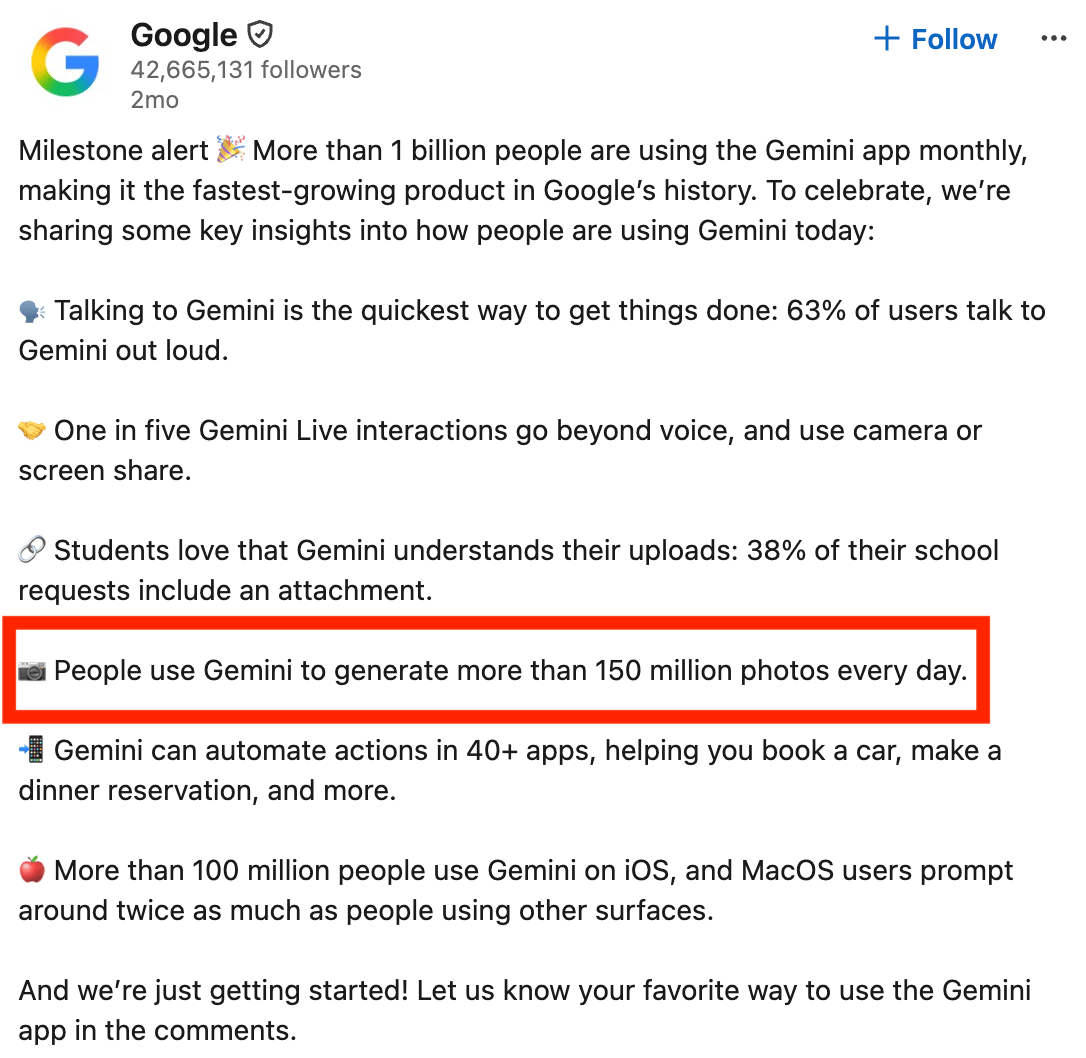
No verified worldwide count tracks how many AI images are generated daily in 2026. The clearest current figures are company-reported platform totals: Google says Gemini generates more than 150 million images a day, while OpenAI says people create more than 3 billion images a week across ChatGPT Images and the GPT-Image models in its API.
For comparison, Everypixel estimated worldwide AI image generation at around 34 million images per day in August 2023.
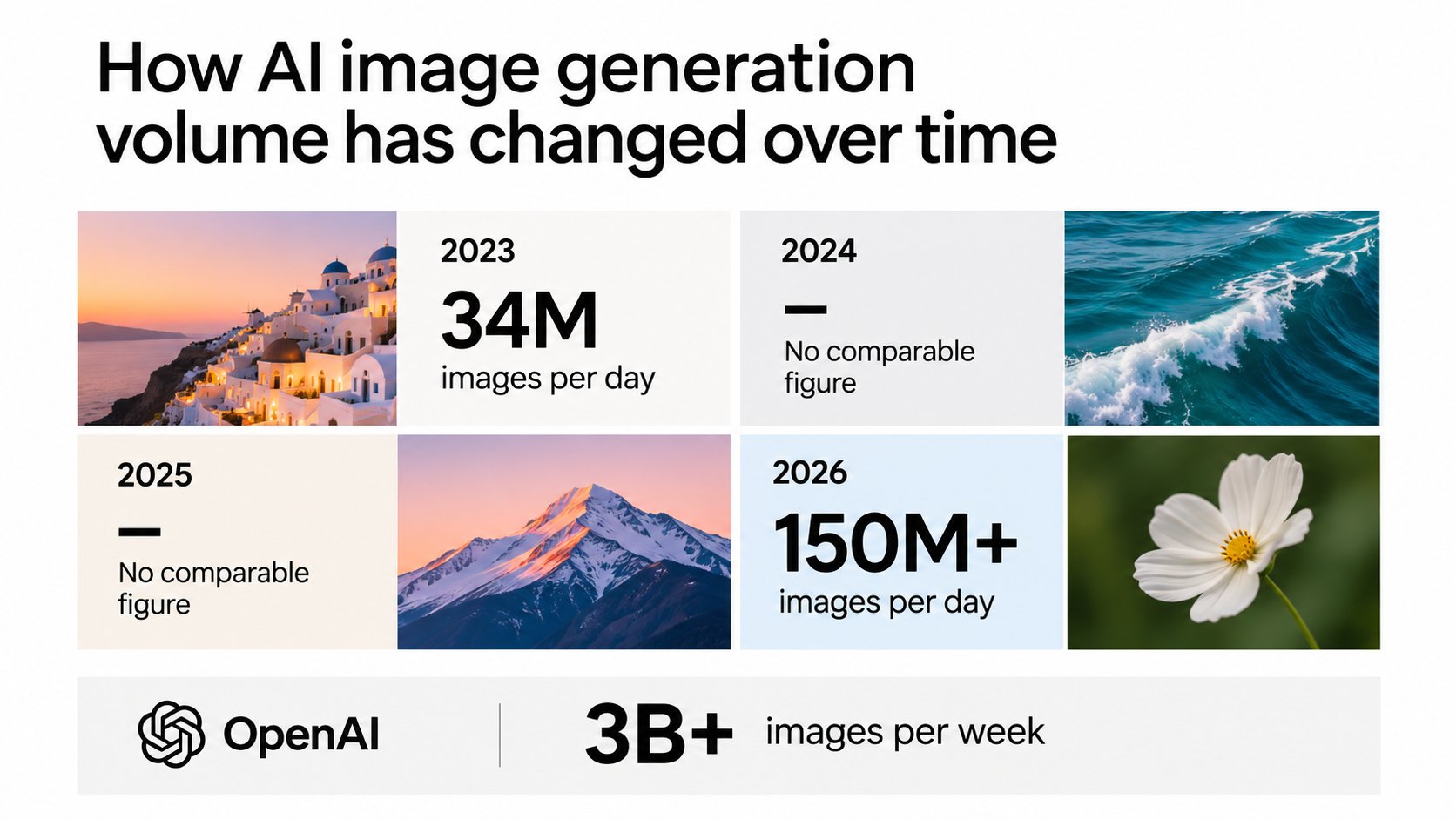
| Year | Reported output | Coverage |
|---|---|---|
| 2023 | 34 million per day | Estimated worldwide output |
| 2024 | No comparable figure | — |
| 2025 | No comparable figure | — |
| 2026 | 150 million+ per day | Google Gemini |
| 2026 | 3 billion+ per week | OpenAI ChatGPT Images and GPT-Image API |
Everypixel's 2023 figure was an estimate based on available AI tool activity and extrapolated generation rates. Google and OpenAI reported totals for their own products, but did not publish detailed counting or deduplication methods.
The figures show the scale of generation on major platforms. They do not provide a like-for-like update of the 2023 worldwide estimate.
How many AI images have major platforms generated in total?
Google reported more than 50 billion images generated with Nano Banana by June 2026. Meta reported more than 20 billion images made using its AI tools by November 2025.
Cumulative AI image generation by platform
These cumulative totals cover different periods and media types; they are not daily generation rates.
| Platform | Reported output | What the figure counts | Reported on |
|---|---|---|---|
| Google Nano Banana | 50 billion+ images | Images generated | June 3, 2026 |
| Meta AI tools | 20 billion+ images | AI-generated images | November 6, 2025 |
| Adobe Firefly | 22 billion+ creative assets | Images, video, audio, and vector assets combined | April 24, 2025 |
| Google Flow | 1.5 billion+ images and videos | Images and videos combined since launch | February 25, 2026 |
Google and Meta reported image counts. Adobe and Google Flow reported broader creative output, which includes other media formats. The companies have not published enough detail to compare their counting methods directly.
What is the AI image generator market size in 2026?
Three market research firms estimate the 2026 AI image generator market at between $484.29 million and $555.1 million. Their reports use different market definitions and forecasting methods.
AI image generator market estimates for 2026
| Research firm | Estimated market size | Report updated |
|---|---|---|
| Fortune Business Insights | $484.29 million | October 2026 |
| Straits Research | $526.3 million | October 1, 2026 |
| Grand View Research | $555.1 million | September 2026 |
Grand View Research includes software and services, platforms, licensing, APIs, subscriptions, and integrations in its market scope. Its methodology draws on proprietary databases, executive interviews, and other market research.
The public summaries from Straits Research and Fortune Business Insights provide less detail about their calculation methods.
These are market research estimates, not audited revenue figures. They offer a useful view of the industry's estimated commercial size. For a broader look at where that growth is headed, see our overview of the AI image generation market.
How accurately can people detect AI-generated images?
People don't consistently distinguish AI-generated images from real photographs. In one study, participants achieved 62% accuracy; another reported just 29% accuracy when evaluating images generated by FLUX.1-dev.
How well do people recognize AI-generated images?
| Study | Finding | Sample and method |
|---|---|---|
| Microsoft Research, June 2025 | 62% correct | More than 12,500 participants; approximately 287,000 image evaluations in an opt-in online quiz |
| Frontiers in Artificial Intelligence, November 2025 | 63.7% overall; 29% for FLUX.1-dev images | 104 participants evaluated 50 images: 25 real and 25 AI-generated |
| Social Media + Society, October 2026 | Not substantially better than chance | 2,091 Danish adults surveyed in June 2024; each assessed seven images from a pool of 52 |
The studies used different images, participants, and test conditions. Their percentages shouldn't be combined into one detection score.
They also measure performance in controlled tests, not people's ability to identify every AI-generated image they encounter online.
Can watermarks detect AI-generated images?
Yes. Some AI image generators embed invisible watermarks that compatible detection tools can identify. Others attach digital records that describe where an image came from and how it was edited. Both approaches can help verify an image's origin, but neither can identify every AI-generated image.
How AI image watermarking works
Not all watermarking technologies work in the same way.
| Technology | How it works | What it can tell us |
|---|---|---|
| Visible watermark | Places a label or logo over an image | Shows an AI label, but can be cropped or removed |
| Invisible watermark | Embeds a hidden signal into image pixels | Helps compatible detectors identify content from supported generators |
| Content Credentials | Attaches signed information about an image's origin and editing history | Helps verify a file's provenance and recorded changes |
Content Credentials use the C2PA standard. Unlike an invisible watermark, they store provenance information with the file rather than hiding a signal in its pixels. The standard also supports photographs and other non-AI media.
Major platforms are adopting image provenance technology
Google's SynthID is one of the largest deployments of invisible AI watermarking. Google reported that it had watermarked more than 180 billion images and videos by October 29, 2026.
In the same announcement, Google expanded its SynthID Detector. The tool became available globally in English and added support for content from selected partner models, including those from OpenAI, NVIDIA, Kakao, and Apple.
OpenAI uses two signals in supported image-generation workflows: SynthID and C2PA Content Credentials. Supported images generated with ChatGPT, Codex, and the OpenAI API can include both signals.
Adobe also supports Content Credentials, which can record information about an image's origin and editing history.
Can these watermarks always identify AI images?
No. Watermark detection depends on the image retaining a signal that the verification tool can recognize.
Some invisible watermarks are designed to survive common changes such as resizing, compression, and filters. However, extensive editing or image reconstruction can weaken or remove a signal. Screenshots and file conversions can also strip Content Credentials.
Independent research has demonstrated weaknesses in some invisible watermarking methods. A 2024 NeurIPS study showed that generative reconstruction could reduce detection across four tested pixel-level watermark schemes while preserving much of the image's visual quality. The study did not test Google's proprietary SynthID system.
A detector finding no watermark doesn't prove that an image was made by a person. The image may come from an unsupported generator, or its watermark or provenance information may have been lost during editing or sharing.
The growing scale of AI images
AI image generation is now happening at an enormous scale. Major platforms report billions of generated images, yet no reliable worldwide count exists.
Detecting AI images remains challenging, too. People don't always recognize them, while watermarks and Content Credentials offer another way to verify their origin.
The bigger challenge is no longer just creating AI images. It's understanding their scale and knowing where they came from.
Several of the models behind these numbers, including Nano Banana and GPT Image, are also available on PhotoGPT. Generate images with these models directly, or start with the introduction to PhotoGPT.
Frequently asked questions
Common questions about how platforms count AI-generated images and how provenance metadata works:
Do AI image generation statistics count unique images or all generated variations?
Major platforms disclose no common counting method. Company figures report generated output, but their public announcements don't consistently explain how they treat repeated generations, variations, edited images, or duplicate files. Researchers should treat these as platform-reported output figures, not counts of unique images.
Can Content Credentials prove that an image shows a real event?
No. Content Credentials verify signed information about an image's origin and editing history. They don't establish whether the scene depicted actually happened or whether the image is factually accurate. An AI-generated image of a fictional event can still have valid Content Credentials.
Can Content Credentials identify the person who created an image?
Not necessarily. The core C2PA standard focuses on an asset's origin and history, not the identity of the individual who made it. It may identify the software or organization that signed the record, but identifying a specific person requires additional identity information.
Does a C2PA watermark prove copyright ownership?
No. Content Credentials are not a copyright certificate or a digital rights management system. They record information about an asset's provenance, but they don't establish who legally owns the image or has the right to use it.
What happens to image provenance when someone takes a screenshot?
A screenshot creates a new image file and normally does not carry over the original file's C2PA metadata. Some systems support recovering lost provenance through digital fingerprints or watermark-based identifiers, but this depends on the implementation. Some supported image-generation workflows use both.